
Out of the Rich Earth
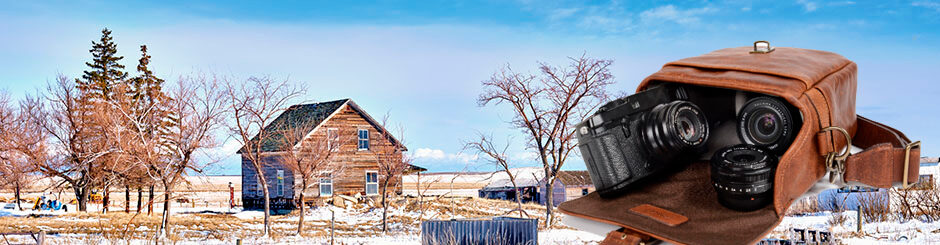


The following image was adjusted using Lightroom masking tools to isolate various areas of the image separately and then make adjustments specific to those layers.
Original RAW File

Isolating the sky using sky masking and then adjusting

Separating the sea and mountains by creating a mask using a colour selection, then Tone and Colour adjustments.

The previous mask is duplicated, then inverted and the sky is removed from the mask. Adjustments to Tone, Colour, Detail and Effects

Isolation of the rocks and bare trees using a colour mask selection. Adjustments were made to Tone, Colour, Effects and Detail.

A brushed layer was added to the show-capped volcano, and the Detail was adjusted. Then, two Liner lays were added diagonally to the upper portion of the sky. Adjustments were made to Tone.

For many years, I have felt that photography has a therapeutic value. To make a good photographic image is to express your emotions, and it certainly helps express things that may be harder to put into words.
I ran across this article during a historical discussion with the Agora School of Experimentation. I found it interesting that 116 years ago people were discussing whether or not a photograph should be purely representational or not and this discussion still persists. A debate at that time and still now draws into question whether or not a photograph can be a work of art. This sentiment is often found in comments such as: “Did you enhance it?” or “Was this photoshopped?” Comments that reflect the thought that altering a photograph somehow distracts from its representation of reality. A photograph’s materiality in print or online of course does not truly represent the objects within its frame, as it is a two-dimensional illusion of reality. In addition, a photograph is about framing, deciding what is in or out of the frame. Omissions or inclusions can certainly misrepresent the reality of a scene. So, a “straight” photograph is not an accurate reflection of reality. This is not to say all photography is art or that photography can not be used in a documentary form.
Robert Demachy’s article, below, points out that both a “straight print” and one that has been altered can potentially be a work of art.
The difference between representation photography and the art of photography is explored in Marius De Zayas, 1913 article Photography and Artisitic-Photography found below. He argues that the primary difference between the two is whether or not the photograph is being used to convey what is seen or what is felt. In his words: “
The difference between Photography and Artistic-Photography is that,
in the former, man tries to get at that objectivity of Form which generates the
different conceptions that man has of Form, while the second uses the
objectivity of Form to express a preconceived idea in order to convey an
emotion.”
On the Straight Print.
Robert Demachy, 1907. Camera Work,19 (July): 21-24.
The old war between straight photography and the other one— call it as you like— has begun over again. It is not, as it ought to be, a question of principle. No, it has become a personal question amongst a good many photographers, because most of them, and especially those who take purely documentary photographs, look to being recognized as artists. It follows that any definition of art that does not fit in with their methods will be violently attacked because the recognition of such a definition would limit pictorial photography to a certain number of men instead of throwing open the doors of the temple to the vast horde of camera carriers.
It is not without certain misgivings that I am attempting to give a clear resume of this ever debated question, for I know that the above paragraph will be used against me and I shall be accused of “pleading for my saint” as we say. As a fact I am doing nothing of the sort, for though I believe firmly that a work of art can only be evolved under certain circumstances, I am equally convinced that these same circumstances will not perforce engender a work of art. Meddling with a gum print may or may not add the vital spark, though without the meddling there will surely be no spark whatever.
My meaning I hope has been made clear. Still there is a second point to be elucidated, and that is the precise signification of a term that we shall be using presently, “ straight print.” According to the sense that is given to this term the whole structure of our arguments may be radically changed and the subsequent verdict falsified. For here is “par avance” my opinion in a few words. A straight print may be beautiful, and it may prove superabundantly that its author is an artist; but it can not be a work of art. You see now that it is necessary before entering into details to give a clear definition of the nature of the straight print as I understand it, and also a definition of the work of art. A straight print, to be worthy of its name, must first of all be taken from a straight negative. There must be no playing upon words in a serious controversy of this nature. One must not call “straight” a bromide mechanically printed, but from a negative reduced locally and painted on the glass side with all the colors of the rainbow. This leads us to describe the straight negative. It will be a negative produced by normal development, or better still by tank development, during which no control is possible; and of course it will not be submitted to any subsequent retouching either on the film or on the glass. From this negative a print will be taken with a normal exposure without local shading. If the paper used for printing has to be developed, it will not be developed locally nor interfered with in any way during development. It will be mounted or framed without its surface being touched by a finger or a brush.
This is my idea of the sense of the term “straight print.” If any readers consider that it is a false idea they had better leave the next pages unread. Now, speaking of graphic methods only, what are the distinctive qualities of a work of art? A work of art must be a transcription, not a copy, of nature. The beauty of the motive in nature has nothing to do with the quality that makes a work of art. This special quality is given by the artist’s way of expressing himself. In other words, there is not a particle of art in the most beautiful scene of nature. The art is man’s alone, it is subjective not objective. If a man slavishly copies nature, no matter if it is with hand and pencil or through a photographic lens, he may be a supreme artist all the while, but that particular work of his can not be called a work of art.
I have so often heard the terms “artistic” and “beautiful” employed as if they were synonymous that I believe it is necessary to insist on the radical difference between their meanings. Quite lately I have read in the course of an interesting article on American pictorial photography the following paragraph: “ In nature there is the beautiful, the commonplace and the ugly, and he who has the insight to recognize the one from the other and the cunning to separate and transfix only the beautiful, is the artist.” This would induce us to believe that when Rembrandt painted the Lesson in Anatomy he proved himself no artist. Is there anything uglier in nature than a greenish, half-disemboweled corpse; or anything more commonplace than a score of men dressed in black standing round a table? Nevertheless, the result of this combination of the ugly and the commonplace is one of the greatest masterpieces in painting. Because the artist intervened.
If Rembrandt had painted that scene exactly as he saw it in nature he would have given us exactly the same impression that he would have felt in front of the actual scene, a sensation of disgust— mingled perhaps with a vivid admiration for the manual and visual skill of the copyist, but without a shadow of any art sensation.
Let us change the circumstances and take as an example a beautiful motive such as a sunset. Do you think that Turner’s sunsets existed in nature such as he painted them? Do you think that if he had painted them as they were, and not as he felt them, he would have left a name as an artist? Why, if the choice of a beautiful motive was sufficient to make a work of art ninety percent of the graphic works in the world, paintings, drawings, photographs and chromos would be works of art, a few of them only are distinctly ugly and not as many commonplace.

Choose the man whom you consider the very first landscape artist photographer in the world; suppose he has, thanks to his artistic nature and visual training, chosen the hour and spot, of all others. Imagine him shadowed by some atrocious photographic bounder furnished with the same plates and lens as the master. Imagine this plagiarist setting his tripod in the actual dents left by the artist’s machine and taking the same picture with the same exposure. Now, suppose that both are straight printers? Who will be able later on to tell which is the artist’s and
which is the other one’s picture? But figure to yourself the artist printing his negative, selectively, by the gum bichromate or the oil process, or developing his platinotype print with glycerine. Even if the other man has used the same printing method one print will have the artist’s signature all over it from the sky to the ground, the other will be a meaningless muddle. F or the man has intervened in both cases. One has made a work of art out of a simply beautiful picture, the other has probably spoiled its beauty and certainly has introduced no art. T h e moral of this fable is twofold. I t shows that a beautiful straight print may be made by a man incapable of producing a work of art, and that a straight print can not possibly be a work of art even when its author is an artist, since it may be identical to that taken by a man who is no artist.
You will answer that a gum or an oil print from a master can be copied by a patient and painstaking worker, just as the above beautiful motive was stolen from the artist— well, you may try. I know of a man who has been copying Steichen to the extent of having canvas background painted exactly like the brush-developed background of one of his gum portraits. I prefer not to speak of the result. That it was all to the credit of Steichen, you may believe.

Not once but many times have I heard it said that the choice of the motive is sufficient to turn an otherwise mechanically produced positive into a work of art. This is not true; what is true is that a carefully chosen motive (beautiful, ugly or commonplace, but well composed and properly lighted) is necessary in the subsequent evolution towards art. It is not the same thing. No, you can not escape the consequences of the mere copying of nature. A copyist may be an artist but his copy is not a work of art; the more accurate it is, the worse art it will be. Please do not unearth the old story about Zeuxis and Apelles, when the bird and then the painter were taken in. I have no faith in sparrows as art critics and I think the mistake of the painter was- an insult to his brother artist.
The result of all this argument will be that I shall be taxed with having said that all unmodified prints are detestable productions, fit for the wastepaper basket, and that before locally developed platinotype, gum bichromate, ozotype and oils, there were no artists to be found amongst photographers. I deny all this. I have seen many straight prints that were beautiful and that gave evidence of the artistic nature of their authors, without being, in my private opinion, works of art. For a work of art is a big thing. I have also seen so-called straight prints that struck me as works of art, so much so that I immediately asked for some technical details about their genesis, and found to my intimate satisfaction that they were not straight prints at all. I have seen brush-developed, multi-modified gum prints that were worse— immeasurably worse— than the vilest tintype in existence, and I have seen and have in my possession straight prints by Miss Cameron and by Salomon, one of our first professionals, just after Daguerre’s time, that are undoubtedly the work of artists. All
is not artistically bad in a straight print. Some values are often well rendered; some “passages” from light to shade are excellent, and the drawing can be good if proper lenses are used at a proper distance from the motive; but there is something wanting, something all important, extremely difficult to express in words. If you can see it there is no use trying to But apart from the absence of this mysterious something, this thumb-mark of the living, thinking, and feeling artist, are there not other things wrong in all straight photographs—faults due not only to the inevitable human errors in exposure and development, but to photography itself, photographic faults in the rendering of values (that no orthochromatic plates are capable of correcting without creating other exaggerations just as bad), faults in the equal translation of important and useless detail, in the monotonous registering of different textures, in the exaggeration of brilliant spots, and in other things, too? What will the pure photographer do when he has detected these faults? If he allows them to remain out of respect for the laws of the pure goddess photography, he may prove himself a high priest photographic, but will he still be a true artist, faithful to the gospel of art? I believe that, unless he has had his fingers amputated according to the dictates of Bernard Shaw, he will feel them itching to tone down or to lighten this spot or that, and to do other things also. But he may not do these things, the Law of the Straight Print forbids it. The conclusion is simple enough, for there is no middle course between the mechanical copy of nature and the personal transcription of nature. The law is there; but there is no sanction to it, and the buttonpressers will continue to extol the purity of their intentions and to make a virtue of their incapacity to correct and modify their mechanical copies. And too many pictorialists will meddle with their prints in the fond belief that any alteration, however bungling, is the touchstone of art. Later on perhaps a sane, moderate school of pictorial photography will evolve. La verite est en marche, mais elle marche lentement.
Before ending I can not but confess my astonishment at the necessity of such a profession of faith as the one I have been making. Pictorial photography owes its birth to the universal dissatisfaction of artist photographers in front of the photographic errors of the straight print. Its false values, its lack of accents, its equal delineation of things important and useless, were universally recognized and deplored by a host of malcontents. There was a general cry toward liberty of treatment and liberty of correction. Glycerine-developed platinotype and gum bichromate were soon after hailed with enthusiasm as liberators; today the oil process opens outer and inner doors to personal treatment. And yet, after all this outcry against old-fashioned and narrow-minded methods, after this thankful acceptance of new ones, the men who fought for new ideas are now fighting for old errors. That documentary photographers should hold up the straight print as a model is but natural, they will continue doing so in sternum for various personal
reasons; but that men like A and B should extol the virtues of mechanical photography as an art process, I can not understand.
I consider that, from an art point of view, the straight print of to-day is not a whit better than the straight print of fifteen years ago. If it was faulty then it is still faulty now. If it was all that can be desired, pictorial photographers, the Links and the various secessionists of the new and the old world have been wasting their time, to say the least, during the last decade.
Robert Demarchy
Photography and Artistic-Photography
De Zayas, Marius. 1913, Camera Work, 42/43 (April/July): 13-14.
Photography is not Art, but photographs can be made to be Art. When man uses the camera without any preconceived idea of final results, when he uses the camera as a means to penetrate the objective reality of facts, to acquire a truth, which he tries to represent by itself and not by adapting it to any system of emotional representation, then, man is doing Photography.
Photography, pure photography, is not a new system for the representation of Form, but rather the negation of all representative systems, it is the means by which the man of instinct, reason and experience approaches nature in order to attain the evidence of reality.
Photography is the experimental science of Form. Its aim is to find and determine the objectivity of Form; that is, to obtain the condition of the initial phenomenon of Form, phenomenon which under the dominion of the mind of man creates emotions, sensations and ideas.
The difference between Photography and Artistic-Photography is that, in the former, man tries to get at that objectivity of Form which generates the different conceptions that man has of Form, while the second uses the objectivity of Form to express a preconceived idea in order to convey an emotion. The first is the fixing of an actual state of Form, the other is the representation of the objectivity of Form, subordinated to a system of representation. The first is a process of indigitation, the second a means of expression. In the first, man tries to represent something that is outside of himself; in the second he tries to represent something that is in himself. The first is a free and impersonal research, the second is a systematic and personal representation.
The artist photographer uses nature to express his individuality, the photographer puts himself in front of nature, and without preconceptions, with the free mind of an investigator, with the method of an experimentalist, tries to get out of her a true state of conditions.
The artist photographer in his work envelops objectivity with an idea, veils the object with the subject. The photographer expresses, so far as he is able to, pure objectivity. The aim of the first is pleasure; the aim of the second, knowledge. The one does not destroy the other.
Subjectivity is a natural characteristic of man. Representation began by the simple expression of the subject. In the development of the evolution of representation, man has been slowly approaching the object. The History of Art proves this statement.
In subjectivity man has exhausted the representation of all the emotions that are peculiar to humanity. When man began to be inductive instead of deductive in his represented expressions, objectivity began to take the place of subjectivity. The more analytical man is, the more he separates himself from the subject and the nearer he gets to the comprehension of the object.
It has been observed that Nature to the majority of people is amorphic. Great periods of civilization have been necessary to make man conceive the objectivity of Form. So long as man endeavors to represent his emotions or ideas in order to convey them to others, he has to subject his representation of Form to the expression of his idea. With subjectivity man tried to represent his feeling of the primary causes. That is the reason why Art has always been subjective and dependent on the religious idea.
Science convinced man that the comprehension of the primary causes is beyond the human mind; but science made him arrive at the cognition of the condition of the phenomenon.
Photography, and only Photography, started man on the road of the cognition of the condition of the phenomena of Form.
Up to the present, the highest point of these two sides of Photography has been reached by Steichen as an artist and by Stieglitz as an experimentalist.
The work of Steichen brought to its highest expression the aim of the realistic painting of Form. In his photographs he has succeeded in expressing the perfect fusion of the subject and the object. He has carried to its highest point the expression of a system of representation: the realistic one.
Stieglitz has begun with the elimination of the subject in represented Form to search for the pure expression of the object. He is trying to do synthetically, with the means of a mechanical process, what some of the most advanced artists of the modern movement are trying to do analytically with the means of Art.
It would be difficult to say which of these two sides of Photography is the more important. For one is the means by which man fuses his idea with
the natural expression of Form, while the other is the means by which man tries to bring the natural expression of Form to the cognition of his mind.
Marius de Zayas
Artist are known for their creativity, not that they are the only ones who are creative, but this is key to their practice. Csikszentmihalyi, who has made a lifelong study of creativity and built on the work of Maslow, defines creativity as follows: “…creativity results from the interaction of a system composed of three elements: a culture that contains symbolic rules, a person who brings novelty into the symbolic domain, and a field of experts who recognize and validate the innovations.” So as he puts it creativity is something that happens between one’s internal thoughts and the sociocultural context in which one lives. The net result of this interchange is “any act, idea, or product that changes an existing domain, or that transforms an existing domain into a new one. ” One could characterize this interchange as a “dialectic” where the artist initiates a conversation between his novel idea and the cultural symbiotic rules.
I believe this definition of creativity is a good description of what occurs in the world of “experimental photography.” Csikszentmihalyi’s definition reflects Ludimilla Caravalho’s suggestion that experimental photography is: “A series of practices, aesthetics, and methodologies that diversify contemporary photography, in works that belong to the field we call experimental. These are works made through the unconventional use of technologies and challenge the attempts of quick and precise classification. Hybrid, irregular and unpredictable images that rewrite the history of the photographic medium.” The net result of this experimentation or artistic dialectic with cultural norms is a shift in the domain or perhaps a continual shift.
Experimental photographs are constantly testing and seeking to expand the media by combining or altering historical and modern techniques and in the process constantly challenging the notion that there is a right way to make a photograph. As Jerry Uelsmann suggested in 1967, “the contemporary artist, in all other areas, is no longer restricted to the traditional use of his materials or to the exclusive use of traditional materials. In addition, he is not bound to a fully conceived, pre-visioned end.” Or as Edward Weston puts it, “I never try to limit myself by theories. I do not question the right or wrong approach when I am interested or amazed, – compelled to work. I do not fear logic; I dare to be irrational, or really never consider whether I am or not. This keeps me fluid, open to fresh impulse, free from formulae.” He further states, “I would say to any artist—don’t be repressed in your work- dare to experiment—consider an urge—if in a new direction, all the better.” Marc Lenot’s phrase “play against the apparatus” describes the essence of creativity, that is described in Csikszentmihalyi’s work and the thoughts of Uelsman. In other words, the experimental photographer’s journey is on the same path as an artist.
Experimental photographers, as a result of this artistic play, are creating a renaissance in the analog and digital worlds. An explosion of new ideas and methods through which traditional photography concepts are constantly being rewritten. So, as Jean-Claude Lemagny, Michel Poivert and James Elkins suggest, these photographers are no longer trying to reflect the world around us accurately but creating images more akin to abstraction as they often lack an accurate representation quality. So today, the initial steps taken by the pictorialists to see photography as an art form through simple manipulations of the process seem so limited compared to what is occurring today.
One of the issues that frequently emerges with experimental photographers is when experimentation ends, as experimentation results in discovering new techniques that can be codified and are, therefore, repeatable. So when the latest practices begin to be repeated, as one might do when working on a series, can the approach still be considered experimental?
Vilém Flusser has suggested that experimental photography deliberately refuses to comply with the established rules or parameters of the photographic process., but experimentation often leads to the formulation of methods and techniques that are replicated; thus moving away from pure experimentation. This leads to diminished investigation as precision increases. This often occurs when an experimental technique is applied to a series by an artist. This could described as plateauing. Once the series has been completed and perhaps exhibited, an entropic state often sets in. Once in an entropic state, the experimental photographer gets increasingly concerned with the homogeneity of the outcome. Consequently, new bursts of energy usually begin to move the experimenter towards new ideas for experimentation. In other words, when entropy sets in there, it also stimulates a sense of restlessness against the precision. The experimenter then considers where the technique can be stretched, broken or rethought to overcome the entropic state. Thus, there is an ebb and flow to experimentation.
Whether or not it is possible to experiment with digital photography is often raised, as rigid algorithms are often cited as confining this medium. Algorithms often can make specific outcomes highly repeatable, and thus arrest experimentation. However, other algorithmic interventions can modify algorithms, and the photographer is experimenting initially with unpredictable outcomes. Algorithmic systems also interact with artificial intelligence, opening up further experimental worlds. In addition, experimental analog images and other artistic mediums can now be integrated into the digital world. So, this melding of images dispels the notion that experimentation within the digital world might be restricted. Moving back and forth between digital and analog photographic processes is also possible. This creates an intersection where the artist can move back and forth between analog and digital experimentation. This ability puts to rest the thought that the experimental photographic digital world is any more restrictive than analog experimentation.
I would suggest there are four areas in which photographic experimentation may occur. There is the conceptual stage, where they are considering how to extract themselves from the entropy that has set in. Then there is the recording stage, where images are made, and this is quickly followed by or sometimes occurs at the same time as the manipulation stage. The manipulation may involve moving the image through various different techniques to achieve a unique outcome. The final stage in which experimentation can occur is the presentation stage, an audience is invited to engage with images that have been created. This stage may involve attempting with unique printing methods or unique methods of presentation.
In all of these stages, experimentation flows more freely where the artist’s skills are balanced against the challenges there vision creates when trying to overcoming the entropic state. When this occures it is likely that all four stages flow together as if they were one.
Photographers and those experimenting with photography when creating an image often have an outcome in mind before any apparatus is used to create the image. As Ansel Adams infers, this might include “detail, movement, proportion… exposure….” So, the first stage of creation is fundamentally experimental as it is conceptual, and the apparatus decisions to bring it to fruition still need to be developed.
The second stage is the apparatus stage, in which the photographer chooses a creation method, sometimes including the manipulation stage. This can sometimes mean multiple recording methods or manipulations of the image.
The manipulation stage can be as extensive as the recording stage, where the image-creating moves through, various experimental techniques.
The final stage involves others viewing the work. This could include framing or mounting an image, or presenting it in another medium such as websites or projection.
Photography and Artistic-Photography
De Zayas, Marius. 1913, Camera Work, 42/43 (April/July): 13-14.
Photography is not Art, but photographs can be made to be Art. When man uses the camera without any preconceived idea of final results, when he uses the camera as a means to penetrate the objective reality of facts, to acquire a truth, which he tries to represent by itself and not by adapting it to any system of emotional representation, then, man is doing Photography.
Photography, pure photography, is not a new system for the representation of Form, but rather the negation of all representative systems, it is the means by which the man of instinct, reason and experience approaches nature in order to attain the evidence of reality.
Photography is the experimental science of Form. Its aim is to find and determine the objectivity of Form; that is, to obtain the condition of the initial phenomenon of Form, phenomenon which under the dominion of the mind of man creates emotions, sensations and ideas.
The difference between Photography and Artistic-Photography is that, in the former, man tries to get at that objectivity of Form which generates the different conceptions that man has of Form, while the second uses the objectivity of Form to express a preconceived idea in order to convey an emotion. The first is the fixing of an actual state of Form, the other is the representation of the objectivity of Form, subordinated to a system of representation. The first is a process of indigitation, the second a means of expression. In the first, man tries to represent something that is outside of himself; in the second he tries to represent something that is in himself. The first is a free and impersonal research, the second is a systematic and personal representation.
The artist photographer uses nature to express his individuality, the photographer puts himself in front of nature, and without preconceptions, with the free mind of an investigator, with the method of an experimentalist, tries to get out of her a true state of conditions.
The artist photographer in his work envelops objectivity with an idea, veils the object with the subject. The photographer expresses, so far as he is able to, pure objectivity. The aim of the first is pleasure; the aim of the second, knowledge. The one does not destroy the other.
Subjectivity is a natural characteristic of man. Representation began by the simple expression of the subject. In the development of the evolution of representation, man has been slowly approaching the object. The History of Art proves this statement.
In subjectivity man has exhausted the representation of all the emotions that are peculiar to humanity. When man began to be inductive instead of deductive in his represented expressions, objectivity began to take the place of subjectivity. The more analytical man is, the more he separates himself from the subject and the nearer he gets to the comprehension of the object.
It has been observed that Nature to the majority of people is amorphic. Great periods of civilization have been necessary to make man conceive the objectivity of Form. So long as man endeavors to represent his emotions or ideas in order to convey them to others, he has to subject his representation of Form to the expression of his idea. With subjectivity man tried to represent his feeling of the primary causes. That is the reason why Art has always been subjective and dependent on the religious idea.
Science convinced man that the comprehension of the primary causes is beyond the human mind; but science made him arrive at the cognition of the condition of the phenomenon.
Photography, and only Photography, started man on the road of the cognition of the condition of the phenomena of Form.
Up to the present, the highest point of these two sides of Photography has been reached by Steichen as an artist and by Stieglitz as an experimentalist.
The work of Steichen brought to its highest expression the aim of the realistic painting of Form. In his photographs he has succeeded in expressing the perfect fusion of the subject and the object. He has carried to its highest point the expression of a system of representation: the realistic one.
Stieglitz has begun with the elimination of the subject in represented Form to search for the pure expression of the object. He is trying to do synthetically, with the means of a mechanical process, what some of the most advanced artists of the modern movement are trying to do analytically with the means of Art.
It would be difficult to say which of these two sides of Photography is the more important. For one is the means by which man fuses his idea with the natural expression of Form, while the other is the means by which man tries to bring the natural expression of Form to the cognition of his mind.
Marius de Zayas
The Apeiron Exhibition at the Xchanges Gallery and Studios has ended. We want to thank all the amazing people who took in the exhibition, the wonderful people of Eastend, the dedicated Eastend Arts Council / Wallace Stegner House and the Xchanges Gallery and Studios.

Apeiron is a photo-based exhibition depicting life in a small prairie agricultural community on a vast landscape. Two artists engage in a visual dialogue about their perceptions of geography, history, economic hardship, and multifaceted culture. This exhibition invites viewers to immerse themselves in the environment and emotions these images of prairie life evoke.
The Apeiron exhibition results from April 2022, Artists in Residence at the Wallace Stegner House in Eastend, Saskatchewan. His childhood home is set in a land where geology, history and human habitation are intertwined in a town that is an incubator for artists, historians and writers from around the world that find their way to Eastend set among the coulees of Cypress Hills on the old Red Coat Trail, where Sitting Bull retreated.
As cameras produce larger files and your archive increases, storage becomes more complex. Hard drives eventually fail, so you likely store your files on one drive and back them up on another. Once you reach the capacity of those drives, then you are faced with migrating the material to two larger drives, taking the first drives offline or setting up some array of drives. At this point, one begins to think about simplifying things, and RAID drives make more sense. If you are using more than one computer or have to share resources, then a RAID NAS drive might make more sense.
The first problem in understanding RAID is which method of RAID to use. The recommendation, from several sources, is to use RAID 5 or 6. RAID 5 allows you to recover everything if one of your disks fails. If two drives fail, then all your photographs will be lost. Moving to RAID 6 allows for two drive failures, which is added protection but will reduce your storage capacity. In RAID 5 two 10 Terabytes of storage might give you only 16 TB of storage. These RAID versions allow for the hot swapping of drives and various different-sized drives in the enclosure. A RAID 10 requires a minimum of four hard drives, but it will only survive a single drive failure. Thus, RAID 6 is likely the best choice for survivability. Even so, one should always be backing up your RAID drive. Most enclosure manufacturers provide an easy-to-use proprietary system, such as Snyologyies SHR2 RAID. However, keep in mind this locks you into their system, and you can not simply transfer your drives to another manufacturer’s RAID enclosure. Most companies produce these versions for non-professional use.
A quick review of photographers’ sites seems to indicate that Synology drives are a popular choice for storing images. This enclosure, like those of many other manufacturers, can house either 2.5 ” or 3.5″ drives, and the Synology systems 5 bay DS1522+ can scale up to 15 bays using an expansion unit. This is a NAS unit that can also be connected to your home ethernet network.


Storing your images on a NAS works well with Lightroom Classic provided the catalogue resides on your local drive. If work from more than one computer remember that there is no official support from Adobe if you want to place your catalogue and images on a NAS drive. To get around this, use a local sync client to sync a local folder to the NAS continuously or after you finish. Make sure the synchronization has finished before you shut down.
In order to acquire over 20 TB of storage and run with either RAID 5 or 6 you would need a minimum of three bays for RAID 5 and a minimum of four bays for RAID 6. So if one went with four bays Synology’s site suggests the maximum storage would be 49TB using RAID 5 and 32.7TB using RAID 6. Using five bays, these numbers would go from 65TB to 49TB respectively. This would suggest that a five-bay drive would future-proof your storage.


The real downside of RAID is the smallest drive reduces the storage of all drives. For example, if you had a five-bay enclosure filled with 18TB drives your storage with RAID 6 would be 49TB, but if you remove one of these drives and replace it with a 4TB, the capacity drops to 10TB immediately.
Suppose you had a Drobo, a proprietary system that has gone out of business. You have three 8TB drives and two 4TB drives in the Drobo, which has given you over 20TB of storage. If you bought a Synology five-bay enclosure, reformated these drives, and placed them in the bay, you would get using RAID 5 14 TB or RAID 6 10 TB of storage. This is a considerable reduction in space. Unless you opt to use Synology’s proprietary system, then you would jump up to 21.TB, but you would then be locked into their system, and would not be able to move these drives to any other manufacturers’ bays, unless you first download them to an external drive. If you had had the experience of Drobo going extinct, this may not be a scenario you would want to repeat. You may be more inclined to use a transferable method like RAID 5 or 6.
The initial cost would be the enclosure itself, and a five-bay Synology enclosure is listed at $1000CDN. In the scenario above, you would place the three 8TB in this enclosure. Thinking of the future, I imagine you would purchase the most significant drive the system appears to be tested for, 18TB. Two Iron Wolf, Pro NAS drives, would cost $ 440 CDN each. This would mean the total investment would be $1800 CDN before taxes, giving you 29.1TB at RAID 5 and 21.8TB at RAID 6.
The downside here is the storage would remain at 21.8TB until all drives were replaced with 18 TB drives. If you had added only two more 8TB drives, you would have reached the 21.8TB level. If you needed more storage, you would have to replace all the drives. So, what you choose may be dependent on the cost of drives.
The current cost of an “IronWolf NAS HDD, SATA III w/ 256MB Cache” drive is as follows:
Keep in mind the drives you choose should be drives that are designed to be used in as NAS RAID drives and preferably on their compatibility lists.
The cost of the five-bay Synology NAS compared to other options: